

Structuring the music for a birthday party is about much more than making a playlist. You need to factor in the client’s initial guidance, the event’s duration, the running sheet, and, most importantly, how the crowd responds throughout the night.
It’s no surprise that no two birthday parties are the same. A 21st, 30th or 50th will all have different energy levels, music preferences, and pacing, so your job as a DJ is to build the night rather than simply play songs.
Get Initial Guidance from the Client
Around a week before the event, I discuss what the music should look like with the client.
This initial guidance could be:
- A Spotify playlist
- A playlist they’ve created themselves
- An existing playlist they like
- A shortlist of 20–40 songs, including both must-play songs and don’t-play songs.
Based on that information, I’d usually compile a crate of around 60–80 songs. As a rule of thumb, I prepare around 20 songs per hour. For example, a five-hour gig would have roughly 80 prepared songs, plus around an hour of background music to start the night.
Background music might be a pre-mixed set or carefully selected music that matches the style the client requested. If I want to cover a few basis, I might play a mix that has multi-genre appeal, for example 90s songs remixed to sound more relaxed.
I also have a collection called Verve Remixed that centres on the concept of classic Verve tracks, remixed by contemporary electronic music producers and DJs. The songs featured appeal to fans of the original recordings and to younger generations, so everybody is happy.
Organise Your Library into Tiers
One habit that’s made my sets much easier to manage is ranking songs into three tiers.
Tier 3: Known artists and recognisable songs, but not necessarily major crowd pleasers. These are great for warming up the room.
Tier 2: Popular songs that can get people moving, but aren’t your biggest weapons.
Tier 1: Guaranteed floor-fillers! These songs consistently get people singing, dancing, and filling the dance floor.
Build the Night Gradually
I usually start the second hour with mostly Tier 3 tracks.
As drinks flow, finger food starts disappearing, and more guests arrive, I gradually introduce Tier 2 songs while still mixing in Tier 3 tracks.
During this stage, I’m also looking for what I call my barometers. These are the people who naturally help start the party. It might be:
- The birthday person
- Someone who’s already dancing
- Someone nodding their head from their seat
- The most energetic group in the room.
Once you’ve identified these people, keep an eye on them throughout the night.
I also make sure I always know roughly where the birthday person and whoever booked me are standing. That way I can quickly pick up on any feedback and gauge whether they’re happy with how the night is progressing.
Factor in the Duration of the Event
An average song runs for around four minutes, but once you account for mixing in and out, I work on roughly 3.5 minutes per track.
That means:
60 / 3.5 = 17
In practice, I still allow 18–20 songs per hour, depending on how much I’m mixing or cutting.
As the night progresses, I’m constantly adding songs to my crate or Prepare list in Serato. I’m always looking ahead so I’m never short on options if the crowd suddenly shifts direction.
By the final hour, I’m usually taking more requests that suit the vibe and leaning heavily into Tier 1 songs.
Work Around the Running Sheet
While birthdays are usually more relaxed than weddings, many still have a loose running sheet.
There might be:
- Speeches
- Surprise performances
- Games or icebreakers
- Cake cutting
- Prayers
These moments shouldn’t interrupt the flow of the night; they’re opportunities to reset the room before building the energy again.
To restart momentum after announcements, you may want to throw in a tier 1 track just to get people motivated.
Read the Room Throughout the Night
In between songs, you need to watch the crowd instead of your laptop or controller. To keep the dance floor filled, identify dance floor signals, observe how the crowd responds to what you’re playing and recognise when a song overperforms while leaning on your barometers to make decisions.
Pay attention to what happens during different parts of a song. If people rush onto the dance floor for the first chorus, that’s a sign you’ve found a strong direction. If they stay for the next song as well, you’ve probably found a pocket that you should stay in rather than changing genres too quickly.
On the flip side, if people start heading to the bar, pulling out their phones, forming conversations with their backs to the dance floor or leaving halfway through a song, it’s often a sign it’s time to adjust your approach.
Finally, trust the songs that surprise you. Sometimes a Tier 2 song gets a much bigger reaction than expected. When that happens, don’t rush to test another genre straight away. Stay in that lane for another two or three songs and let the crowd tell you where they want the night to go.
Follow the Birthday Party Energy Curve
One of the biggest mistakes new DJs make is playing their biggest hits too early.
If you play Mr Brightside, Yeah!, Don’t Stop Me Now, and other tier 1 songs within the first 30 minutes, you’ve left yourself nowhere to go later.
A birthday party usually follows a natural energy curve.
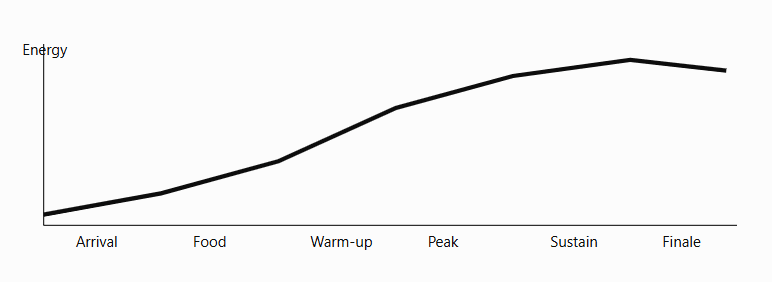
Time | Music approach |
Arrival | Background music, Tier 3 tracks |
Food & drinks | Relaxed sing-alongs |
First dancers | Tier 2 tracks |
Peak time | Tier 1 & Tier 2 tracks |
Final hour | Biggest requests and Tier 1 favourites |
Instead of thinking about BPM alone, think about familiarity. People are often more willing to dance to a song they know at 110 BPM than an unfamiliar song at 128 BPM.
Keep Your Genre Flow Natural
Focus on transitioning between genres smoothly, using bridge songs between decades and avoiding sudden style changes that clear the dance floor. Genre changes are often what clear a dance floor.
Rather than jumping from 90s R&B to hardstyle to country, create bridges between styles.
For example:
- 90s Pop → 2000s Pop → 2000s Hip Hop
- Funk → Disco → 80s Dance
- House Classics → EDM → Festival Anthems
Each transition feels intentional, making people more likely to stay dancing.
Handle Requests Without Losing Momentum
Requests are part of almost every birthday. The trick is making people feel heard without sacrificing the momentum you’ve worked to build.
A simple system is:
- Play it now if it suits the current vibe and pace.
- Queue it later if it fits another part of the night.
- Skip it politely if it completely clashes with the crowd.
If someone requests heavy metal while you’ve got 40 people dancing to 2000s pop, it’s usually better to say, “I’ll find a spot for it later,” rather than emptying the floor immediately.
The birthday person’s requests should always carry the most weight, but even then, timing matters.
Make the Last Hour Count
The last hour is what people remember most. By this stage, you’ve learned what works, who your barometers are and which songs have connected with the crowd.
This is the time to lean heavily into your strongest Tier 1 songs and keep the momentum going until the end. Rather than experimenting with new genres, stack together songs that you’ve already seen work.
Jump on the mic when it feels natural to let everyone know the last songs are coming up. A simple countdown—”We’ve got three songs left”—often brings people back onto the dance floor for one final moment together.
Most importantly, don’t leave your final song to chance. Make it something the birthday person loves, something the crowd has connected with all night, or a song that leaves everyone singing as the lights come up. The last track is often the one people remember most, so finish on purpose rather than simply running out of music.
Final Thoughts
A great birthday DJ set isn’t about playing hit after hit from the moment guests walk through the door.
It’s about preparing properly, building the night gradually, reading the room and knowing when to unleash your biggest songs. If you organise your music into tiers, watch your barometers and adapt as the night evolves, you’ll create a party that feels natural from the first drink to the final song.